Invisible
22.01 — 27.03.2022
Galeri Vitrin, Ankara, Turkey
Solo Exhibition at Goethe Institut-Ankara
Photo credit & text
by Erhan Muratoğlu
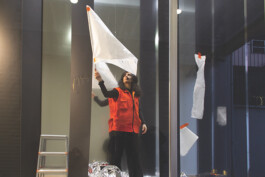
In her site-specific performance, drawing on personal and social experiences, rezzan gümgüm explores the concept of “invisibility” through various objects. This performance, which takes place in a shop window (vitrine in Turkish), where the chosen objects are intended to be seen, focuses on the relationship between the act of seeing and the body, as well as on the impact of points of view on seeing and on their interaction. Invisibility might be described as not being seen or recognized, even though you really exist there. Yet, this description is not sufficient at all.
Recalling the fact that looking is a selective act, deductively, it could be said that we see the things we choose to look at. The phenomenon of “we are seen after we see” reminds John Berger’s endeavour to define the act of “to see / to be seen” and his words on someone’s struggle to describe “how you see everything” through analogy or directly are synonymous with describing “how he/she sees everything”. Our thoughts or beliefs take the greatest share in this phenomenon. Thought and belief affect how we see objects, people and events. Shop windows are for displaying and exhibiting. Transparent surface draws the viewer’s gaze inside, while it cuts and obstructs the physical touch. The tension that is generated by the inability to touch intensifies the gaze directed towards the inside. Firstly, the mind is dragged inside before the body follows running.
The tight link that exists between a shop window that is displaying the trendiest shoes, and another one with construction machines, or a bakery window, or Amsterdam’s Red Light District’s windows is the same link between any household tv screen and a handheld device’s screen. Capitalism maintains its existence by forcing the majority to define its demands in strict limits.
So, how does a shopwindow (vitrin) that begins to obstruct, interrupt the gaze towards the inside, where the shown begins not to be shown operate?
Vitrine, meaning a glass showcase or cabinet especially for displaying fine wares or specimens, comes to English by way of the Old French word vitre, meaning “pane of glass”, which derived from Vitrum, the word for glass in the Latin language. Vitreous (resembling glass), vitrify (to convert or become converted into glass or into a glassy substance by heat and fusion) are some other words derived from vitrine. Even the word vitriol, which on one hand means bitterly harsh, caustic criticism, and on the other, the toxic materials of sulphate of copper, iron, or zinc, comes from the same origin.
Garbage collectors, beggars, women, LGBTI+, immigrants, especially the immigrant women, the ones that are not in the dominant religious community, are invisible; they are not wanted to be visible, even though they actually exist.
Gloriously glaring, silver and golden emergency blankets blind the gaze in rezzan’s performance. The gaze goes blind in the golden glitter of the blanket thrown on the immigrant who survived from a sunken boat.
“Invisible” reminds us that we can embrace the natural relationship between our body and the world; moreover, the possibility of seeing the world and ourselves with brand new eyes. The ability to see from every possible angle becomes a reality, and every gaze could unite in this depth. Therefore, the installation that forms up at the end of the performance gives us a temporal synthesis of all the perspectives and forms summoned at a single nowness that is provided by the movability of the body. It makes us confront the front lines that are hidden in our reflections of our silence and with our quotidian feelings, it reminds us of the experiences of invisibility. It invites to the game of holding the control of the visible, the invisible and the one that is not wanted to be seen.


